Monday, April 23, 2018

Introducing the Floracona Chicken!

Move over Bielefelders, there's a new Uber Chicken on the horizon!
 Introducing the Floracana!
The Goal of this new breed project:
  • Extremely Hardy - almost no comb or waddles, like Buckeye or Chantecler
  • True Dual Purpose - fast growing roos, daily layer hens, like Bielefelders
  • Great Forager - a must for sustainable homestead flocks
  • Gentlemen Roosters - fierce protectors, kind to people and hens
  • Striking Floral Feathers - fun for humans, great camouflage, like Mille Fleurs
  • Rainbow of Egg Color - bonus fun for humans, like Easter Eggers
  • Quiet - roos crow very little and hens don't fuss about eggs, like.... quail?


This breed is still in the fledgling stage, but I am so excited to share that I could not wait another season to go public with my project! So much has already gone into the gene pool of my flock I just have to spill the beans! Here's the breed list to date:

Bielefelder was my starting point. They were going to be the last breed I ever needed, as the sounded like the perfect chicken. Huge gentle roos, hens that popped out a big, beautiful, heavy (not kidding) egg a day, and autosexing to top it off. So why was this not my last chicken? Three reasons. First, they ate like pigs and were lazy. They would rather stand around the feeder and chow down and get fat than patrol the countryside to feed themselves. Maybe it was just my flock, but this was not working out for me at all. Second, though they are hardy, the tall comb and large waddles are a problem in the north where temperatures are just too cold to flaunt such accessories. Even with a rose comb, floppy waddles are just not ideal. Reason number three, they all look exactly the same. Maybe that's great if you can't stand to get attached to your food, but I love to get to know individuals, so for me, short of always having a mixed flock, I need something with speckles or other unique markings.

Easter Egger-  I was given 4 EE hens, which seemed like a great idea because their eggs would be our eating eggs as they were completely different than those of the Bielefelder and would be easy to spot. But they were so beautifully blue! Being the diversity loving gene-happy breeder that I am, of course it didn't take long for me to see a blending of the gene pool. Who knows what breeds went in to create those Easter Eggers? But a little bit of a mystery is a fun thing! So into the incubator went my first Easterfelders!

Speckled Sussex and Mille Fleur d'Uccles-  I needed flowers. I had regained a few of my original Mille Fleur d'Uccles from  my daughter, but I wanted large fowl flowers, So we got Speckled Sussex. Loved loved loved the breed! I would still go back to them in a heartbeat! Great foragers, sweet, curious, ...Shortcomings? Large comb and waddles in the boys, and not quite enough eggs, though I knew good breeding could fix that. But I can't let go of the blue eggs. I just love colored eggs!

  Meanwhile...
Easterfelder Gen 2-  Two of my second generation Easterfelder chicks grew into incredible roosters that made me rethink everything. I have never seen such a rich rainbow of iridescent color in a chicken! This got me to thinking about the possibility of creating my own breed. But it would take me a while to really decide where I would truly go with the idea.

Buckeyes- Hardy! Still not satisfied with finding a true cold hardy breed, I derided on adding buckeyes to the zoo. Noisiest chicks I ever had! But they grew into the quietest chickens I ever had, go figure. Buckeyes are Great foragers and can even teach other chickens how to forage too! And they thrived in the cold weather with no complaints. But...They all look alike, and egg laying is the average every other day, and of course, are not blue.

Mille-Speckles- All these crazy chickens went together in the same pen over winter 2016, so silly me, I put eggs in the incubator. Out of that batch popped two of the most incredible roosters I have ever seen!  They appeared to be Speckled Sussex/Mille Fleur/ Bielefelder!

Ameraucanas- I officially set off on a mission. At first, this mission was to breed Speckled Ameraucanas using Speckled Sussex and Ameraucanas. But I soon decided that all these wonderful traits I had collected could be combined to create a whole new breed of chicken! I made two breeding pens. In one pen I had Ameraucana roos over my various spotted mixed hens. In the other pen were my four splendid spotted roosters over Ameraucana hens. The first generation I selected only chicks that had a pea comb or close to a pea comb. I let all these select chicks grow up and then I selected the roosters based on form. Big, proud, strong legs, alert. Those that were obnoxious with the ladies, too noisy, small, thin, were omitted. The 4 selected roos look mostly Ameraucana in form. All hens were allowed to breed, but large eggs are the ones incubated. Most of the eggs are blue or minty green, since they are all half Ameraucana, but we do have a couple that skipped the blue egg gene and lay cream and brown. my favorite color is from my two girls that lay an olive-tan egg.

Floracana!- So here is the first hatch of this year's generation! Egg colors are fantastic! Chick colors are all over the board, blue, black, white, quite a few mottled, and some are indeed looking speckled!  I am really excited to watch them grow up and see how they feather out this year!    Stay tuned for updates! :)


Monday, March 20, 2017

New Name! Big Changes!

Yes, you're in the right place, but it's time for a change!
             Hawanasa
Our name is from two Cherokee words, Hawa, meaning "Welcome", and Awanasa, meaning "My Home" So our little homestead name means "Welcome to My Home."  And that's just what this blog has always been about. Homesteading! Home grown food and medicine, home canned and preserved food for winter and hard times, sustainability to protect your home for always.
I will also be adding my heartfelt spiritual side to the blog. No religion, as I rather detest what modern religion has done to true WORTHship. As I bring in my Life Coaching facets into the mix, look for uplifting messages, posts on simplifying,  reducing waste, getting back to nature, reducing the clutter in our physical and spiritual lives. It is all connected!  :0)
My home to your home! 
Welcome to Hawanasa! :)

Tuesday, December 6, 2016

EGGS OF BLUE!

Nothing beats your very own home grown fresh eggs. Except your very own BLUE and GREEN eggs! 
Our new developing Easter Egger flock is largely made up of pure Ameraucana hens and roosters, meaning many of the chicks will be pure bred Ameraucana.


Three of our roosters are part of a project to add amazing flowered feathers to the blue egg world, so some of the babies may have these roos as their dad. These amazing roosters have such amazing, deep, iridescent colors that just sparkle and shine in the sunlight!


We also have a pure Ayam Cemani rooster! The babies from eggs from these boys will lay blue, mint, light olive, or maybe gray, depending on how much of a dose of pinkish tan egg gene they get from dads.

 Babies from the cemani boy will lay blue eggs like their mothers, since cemani boys carry only white egg gene, however, these babies will be black to the bone like their father! 


ALL the babies from our blue eggs will have the blue egg gene as they are ALL from our pure Ameraucana hens. 


If you like, we do also have eggs from our buckeye and RIR girls if you want to add a few of those for a great Easter egger mix. Many of these eggs will have Ameraucanas as their dads, so odds are about 50/50 that babies hatched from these eggs will still lay various shades of green/blue eggs as adults from the blue gene carried by their dad. The other half will lay varying shades of pinkish/tan. 


 Eggs are $25 a dozen. All blue eggs, $35 a dozen.
We are located in the Chattaroy/ Deer Park area, but we can deliver to downtown Spokane on Mondays or occasionally by appointment depending on when we will be in town. 
Send me a message if interested!

Sunday, November 6, 2016

Hatching Cracked Eggs


Oh no! I just cracked this beautiful blue egg as I was on my way to put it in the incubator! Argh! 😫
But check this out:

Many cracked eggs can still be successfully hatched with a bit of Scotch tape! You have to be able to cover every hairline crack, but not cover more than 30% of the egg so the shell can still breathe. You can candle the egg to check for hairlines. The light makes them stand out nicely. 

21 days later: 
Look closely and you can see it's hatching! 


A healthy baby chick! Despite a rough start! Yay! 😃

Friday, September 16, 2016

Chamomile Harvest

I spent a lovely quiet late afternoon picking chamomile flowers in the garden. Not many flowering plants can match the enthusiasm of chamomile.
Hundreds of tiny daisy-like blossoms cover a typical happy mature plant. Just looking at it brings joy and a sense of peace and tranquility. While I was picking, there must have been five hundred little bugs representing a dozen species. Paper wasps and honey bees mostly, but also flies, bumblebees, and a few beetles.  


Chamomile is a calming herb. It calms the nerves, calms the tummy, calms the mind. Maybe it could be called "calm-o-meal"! Making a tea and sipping before bed is a great remedy for insomnia. It combines well with lavender for a really powerful sedative punch. 


After picking until I just didn't want to pick anymore (I could have kept picking for a couple more hours, and still not have picked them all!) I took my bucket of flowers inside and spread them on a roasting pan to dry. I put the pan in a warm oven, (about 100 degrees) and will stir the flowers around a bit as they dry. After drying, they will go in a quart jar with a tight lid for use all winter long, until next year, when they will be blooming all over the garden again!


Another use for this happy bright flower is for beauty and body care. As a hair rinse, it gently conditions as well as lightens the color of your hair. Simply use a tea to rinse and leave on to air dry.  As a skin cleanser and tonic, chamomile will sooth irritated skin, tighten wrinkles, and relieve puffy eyes.


Wednesday, April 20, 2016

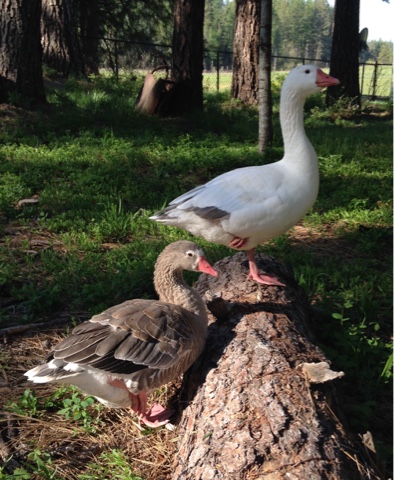
Cotton Patch Geese Pair For Sale


Spokane, Washington. Asking price, $100. Will consider some trades, interested in Black Shouldered Peacocks, Olandsk dwarf, and production blue-egg chickens. 


It is with deep sadness and regret that I must admit I need to sell our pair of cotton patch geese. They deserve better than what we are able to offer them at this time. For one, they need a larger family. We have only the two of them, and they spend their days seeking the company of others, either looking in the front door for us, or pacing the fence to try to socialize with the chickens across the way. They also deserve more water than their kiddie pool. When we moved, it was our intention to find a place with a pond, but it didn't work out that way. We got a river instead! I'm not complaining, but obviously that's not going to work out so well! I'd love to see our geese go to someone who has a pond for them to frolic in! 


So here's their stats:
Both are Walker line that I bought from Regina Hembree Breland in Mississippi. Amanda is almost 2, and Logan is just turning 1 year old. Amanda hit the nest early this year and laid 3 clutches of 7-8 eggs for a total of 24 eggs! Unfortunately, they were all infertile as Logan was maybe just a little too young to know what to do. However, Amanda looks like she might nest again soon? 


I need to sell them locally, as I have no desire to make them deal with the danger and stress of shipping. I might consider Delta Dash if someone wants to go that route. 


These are wonderful pets as their personality is simply charming! They will follow you all around the yard, always sharing a close look at whatever you are doing. They are sweet and gentle. Amanda loves to be petted and cuddled when she is in the mood. 


If you are interested in these beauties, please contact me! You can send me a gmail at delilahra. Thank you!


Friday, March 4, 2016

Modifying a Tray for Quail Eggs

So I have decided to get back into coturnix quail. We got a bunch of eggs from a local guy with a great line of jumbo coturnix. Our "universal" egg trays would not accommodate the huge-but-still-smaller-than-a-chicken eggs, so I sat and thought for a while about how to make the trays work somehow while we wait on our new partridge egg trays to come in the mail. I tried running a string across the bottom, which kept the egg from falling through, but there was no way to place a string higher to stop the egg from flopping all around when the tray tilts. So I was kinda stumped. Then it hit me. The answer was sitting right in front of me. Paper egg carton cups! Woot! It worked! 
Clever, huh? :)


Monday, January 18, 2016

DIY Sauerkraut!

It’s nice to see modern research catching up with ancient knowledge. We are re-learning that fermenting food is the best way to maintain proper gut bacteria populations, and therefore keep our immune systems functioning at optimum levels. One of the best sources of beneficial bacteria is also the easiest to make- good old fashioned sauerkraut!  You can make it one head at a time, in one quart jar, or make it by the bucketful using a pile of cabbages. If you use a few purple cabbages in your mix, your kraut will turn bright magenta when it’s ready to eat! 


1. Chop Cabbage. Start by removing wrapper leaves, browned edges, and blemishes. Give it a good rinse. Then quarter it so you have a wedge of stem in each slice. Slice out the wedge from each quarter. Chop cabbage into fine shreds with a good chef's knife, or run through a food processor. Toss shreds into a big wide bowl.  

2. Add Salt. 1 tablespoon to 1 average cabbage. For a bigger head, add another teaspoon, or for a jumbo head, another tablespoon. Do not use salt with iodine or anti-caking agent as it will hinder bacterial growth. I use natural salts which are full of trace minerals.

 3. Mix. With clean hands, dig, toss, mix, and distribute the salt all through the cabbage. After you get it all tossed and mixed, let the kraut sit for a few minutes so the salt begins to pull the water from the cabbage. Tip- Do not disinfect your hands or use soap with lotions or perfumes. You don't want that stuff in your food! Just use simple soap and water.

 4. Pack. Start stuffing kraut into clean jars or buckets. They can be sterilized, but they don't have to be. I find the kraut is better if the containers are not sterile. Keep stuffing. I use wide mouth jars and use my knuckles to keep pushing the kraut down. You keep stuffing until the juice and kraut are both about two inches from the top of the jar. (prevents overflow) Place a glass weight or clean flat quartz stone on top to keep kraut under liquid. For buckets, find a sturdy plate that fits snugly inside the bucket, place on top of kraut and press down firmly until plate is covered in liquid.

 5. Adjustments. What you want is very tightly packed kraut that is completely below the surface of the juice that has been extracted from it. If you need more liquid, mix 3/4 teaspoon salt per cup of water and add as needed.

 6. Monitor. Cover containers and monitor for 3 or 4 days at around 67°F. Anything above 68° can start growing yeast, and anything below 65° slows fermentation. I highly recommend airlock lids for fermenting in jars, but I do just fine using canning lid flats. Just set a flat on top of each jar. Do not leave a tight lid on a jar for an extended period or the pressure of developing gasses will break your jar! Several times daily, remove the flat and pack the kraut down releasing bubbles. Then replace the flat. I would do the same if using fermenting lids. For buckets, press down on the plate and remove any bits of cabbage on top. Cover loosely with bucket lid. Do not ignore your ferment! Bubbles expand your liquid and containers nearly full can overflow when you are not looking!

7. Taste! After about three days, taste your kraut. If it's rich and sweet, you're done! Store in the fridge or cool cellar between 35° and 55°.  As long as your ferment is alive, do not seal your jars! If you use the plastic lids screwed on loosely, that works. Remember to check occasionally to make sure the kraut stays below the juice. Sauerkraut will keep like this for 3 or 4 months. Maybe as long as six months under perfect conditions. 


Friday, November 6, 2015

Homecoming!

  Introducing the new home of Qwatra Gardens! After years of dedicated effort, diligence, planning, and tight budgeting, Chuck and I have found our little piece of heaven! I wake up every morning and can't believe we live here! We could not have possibly found anything more perfect! Right now we are renting, but the owners have said they will be selling in the near future, so guess who's first on the list to buy! 


The wildlife here is CRAZY abundant! We have only been here a week and we have seen resident flocks of deer, swarms of turkeys, herds of ravens, dozens of squirrels playing in the trees (and leaving piles of pine cone scales all over the ground!), an eagle sitting in the top of the tree above the chicken pens (covered in chain link for a reason!), I heard an elk trumpeting just around the river bend, (yes I just said that!), and a woodpecker was knocking on our bedroom wall, and was then sitting on the balcony outside our bedroom door this morning!  Let me remind you that it's only been our first WEEK! I'm in paradise! Let's just hope we can keep the bears out of the kitchen! ;)
  We only have 5 acres at present, but that will be just about right for a small scale to start. I trust Creator and know full well that when the time is right, more land will become available for us to purchase. The front of the property out by the road is sunny and flat and will be the place for the greenhouse and the majority of the gardening. It will take quite a fence to discourage elk, moose, rabbits, raccoons, and quite probably bears. Of course, we will just have to plant a few mulberry trees and keep everyone fed, fat, and happy! We have permission to grow an edible landscape and short of chopping trees (not that we would consider that anyway) are at liberty to grow whatever we like in the flower beds and planting areas around the house! I can't wait to get started!


Wednesday, September 2, 2015

Here Come the Buckeyes!


Bringing Back the Buckeye
I have been patiently waiting for Buckeyes, and now I am finally rewarded! This very special breed is making a comeback from near extinction, a fate many breeds were and still are facing after the introduction of commercial hybrid chickens that convert feed into meat and eggs with such tempting efficiency that almost all else is ignored. Now the farm world is realizing what a mistake that is. Hybrids are weak. They are incapable of reproducing themselves, are prone to disease,  cannot forage well, can't defend themselves, and as a result, quite frankly, commercial grade chickens are severely lacking in personality!
Buckeye Roo, Crains Run Ranch

So, lesson learned, farmers and homesteaders are turning once again to old heritage breed chickens. And in my opinion, the Buckeye tops the list! Buckeyes were created as a breed in Ohio; the only American breed credited to a woman as its creator. With their compact pea combs and short tucked waddles, these birds were made for survival! Whether hot and dry or shivery cold, Buckeyes are right at home, scratching and pecking for this and that, able to find and forage for most if not all of their own food.The hens are excellent mothers and will happily raise their own babies if given the chance. The roos are watchful protectors, but are not aggressive to people. (though there is always that ONE)
 This breed is noted for being curious and friendly, and will gladly accept treats right from your hand. Some even enjoying being held and petted or even riding around on your shoulder. Roosters weigh in at 9 pounds; hens are about 6 1/2 and lay a light tan egg every other day. 
Strombergs Hen
After asking around and waiting for several breeders, I finally decided to ask Strombergs if they had a few, even though they are sold out according to their website. Strombergs is recognized by the American Buckeye Club for their line of Buckeyes. It was my lucky day! After checking with the incubator room, they had just enough to fill my order, and said there probably wouldn't be any more till spring! So we will be getting our babies on Sept 10th. As I expected, there is a lot of demand for this breed, and more buyers are lining up than I have chickens! I ordered 100, 88 pullets and 12 cockerels, so I will be selling 10 starter flocks of 7 pullets and a roo, and keeping the last 2 roos and about 18 pullets for starting our own flock. We will grow them out over winter and be ready to breed in the spring! WOOT!
decided to ask Strombergs if they by any chance had a few extras, even though their website says they are sold out for the year.

Friday, August 28, 2015

Speckled Sussex


I am super excited to announce our new flock of Speckled Sussex! We have 11 hens and two roos. We bought them as adults from a local farm from three young brothers who started their own business! The chickens each have names, though I can't remember them all yet. The roos are Jeremiah and Markus. That's easy enough. The girls are Veronica, Ruby, Screech, Linda, Philadelphia, Daisy, Leigha, Carry, Snow, Charity, and Constance. So far I know Ruby, Snow, and Constance.
Speckled Sussex are amazing dual purpose chickens. They are nice size birds; roos are around 9 pounds and hens come in at around 7.
Sussex chickens lay a light cream egg about every other day. See the larger eggs in the picture to the right (smaller ones are bantam eggs). We have had our girls only a few days, and they really didn't stop laying, even during their transition period. Usually after moving hens to a new location, they will stop laying for a couple weeks until they get used to their new home. But these girls took it all in stride and continue to lay about 3 to 5 eggs a day. I expect that to bump up to a solid 5 or 6 eggs a day in another week or so.
The best part about Speckled Sussex is their ability to forage and feed themselves! They eat anything and everything! Whether you're a prepper looking for a chicken that can survive Armageddon, or just someone looking for a chicken that won't break the piggy bank, this is the breed for you!
As an added bonus, this breed is super friendly and entertaining! They are such bundles of personality and so fun to watch! Since each one looks different, it's easy to keep track of which one is which and fun to give them names.
I'm looking forward to my adventures with this breed! And of course, I already have a breeding project in mind! ;)
Jerry, lost his tail in the move, but foot is better! 


More to come!

Wednesday, August 26, 2015

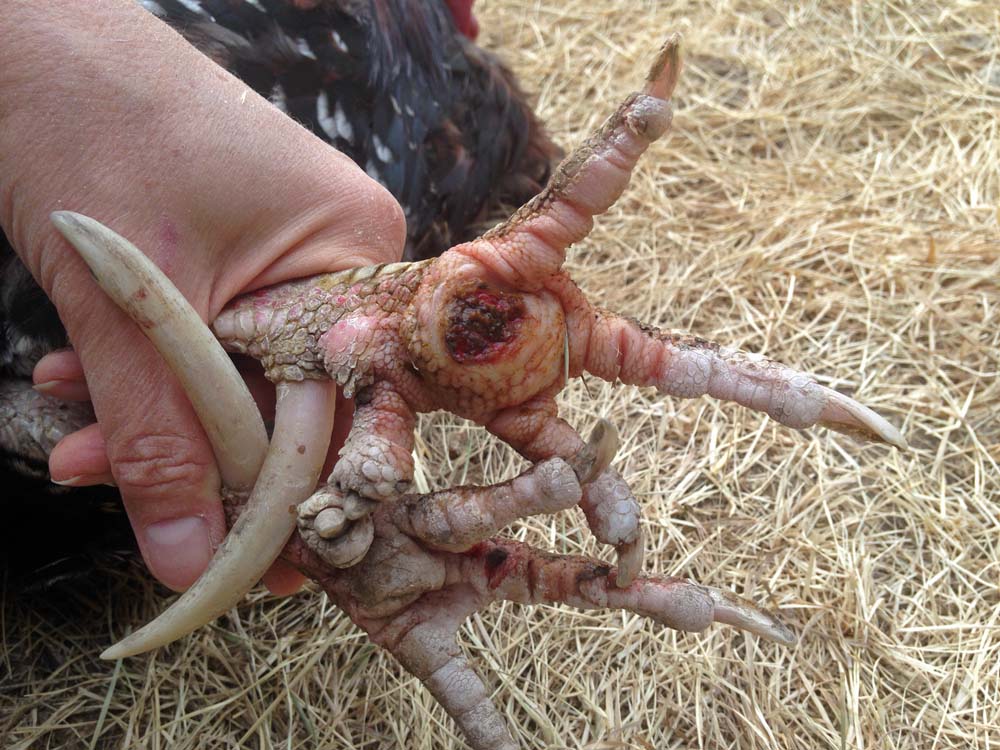
Bad case of Bumblefoot

New Chickens! I'll write a separate post about them soon, but we inherited one small problem. Jeremiah, the rooster, was battling a pretty nasty case of bumblefoot. Now I'm actually using that as a rather blanket term for an open, infected, swollen wound on the bottom of the foot. Poor Jerry was limping around, obviously in a great deal of pain. In my initial exam, I learned this was a very deep round hole, plugged with a deep hard cork made of a bloody scab full of all sorts of dirt, tiny gravel, and grass bits. The scab had deep cracks going all the way down to the irritated open hole, that continually reopened and
allowed fresh bleeding. So for a few days, he came inside into a quarantine bin of pine shavings that wouldn't get packed into his wound. There he could stay put, and give himself a chance to heal! He was quite happy to accept that offer, and spent most of the fist few days sitting quietly or snoozing with his foot stretched out. We got his owie all cleaned up, which took a great deal of soaking in salt water with turmeric added to disinfect and stimulate healing. Then we put a few drops of oregano oil into the wound. After the fist couple days, I alternated the oregano with lavender oil; plus he got a few lavender drops in his bin to help with the idea of calm and healing. It is going to take a long time for this foot to completely heal, but I am happy to report that the swelling is much better and it is healing quite nicely! We will keep after it, and I'll report back as he gets better! :)

 Update! Sept 4...
He is back out in the pen with his girls, and since they are on grass, it is much easier on his foot. He is still limping, but not nearly as bad, and he still sleeps in the nest hut because it's too painful to jump up to the roost. But his foot is looking much better! :)


Friday, August 14, 2015

Mille Fleur D'Uccle

First, if you don't know how to pronounce that last word, it's like "Dew CLAY". It's a city in France where these delightful little rascals are from. Mille Fleur is the name of the color pattern and is French for "Thousand Flower," which is a fitting name for a chicken with a thousand spots! These are some of the world's most colorful chickens, though they are pint size. This is a true bantam breed, with no large size version. Roos tip the scale at a whopping 26 ounces, with the hens not far behind at 22 ounces.
But what they lack in size, they make up for in spirit, not to mention egg laying ability! Our little half pints pop out a white to barely faint cream egg nearly every day! Their eggs are a bit small, but they are actually kinda huge compared to the size of the little bird! They readily go broody if given the chance, and make good mamas. They are great foragers, and it is such fun to watch them chase a grasshopper or moth across the yard. Their fluffy beards and feathered legs and feet really add endearing comedy to their antics.
Our birds were purchased as show quality stock. Our ladies, Prima, Bella, and Dona, are from a breeder north of Spokane who raised multiple show winners from her line, and our roo, Marcel, is from Oregon where he won best in show at the state fair! I'm looking forward to trying my hand (wing?) at the fair. Sadly, Prima is my favorite, but she isn't up to show standards; she has clean legs and feet. I prefer the clean legs and I think they do too. Foot feathers are messy and in the way. They trip on them and are always having to clean them. When not in show dress, I will sometimes cut their feathers off their feet for them. They really appreciate it.  Especially in winter when their feet tend to get packed with snow. :)

Prima
Marcel